“Lines of Control – Flexible Spaces“
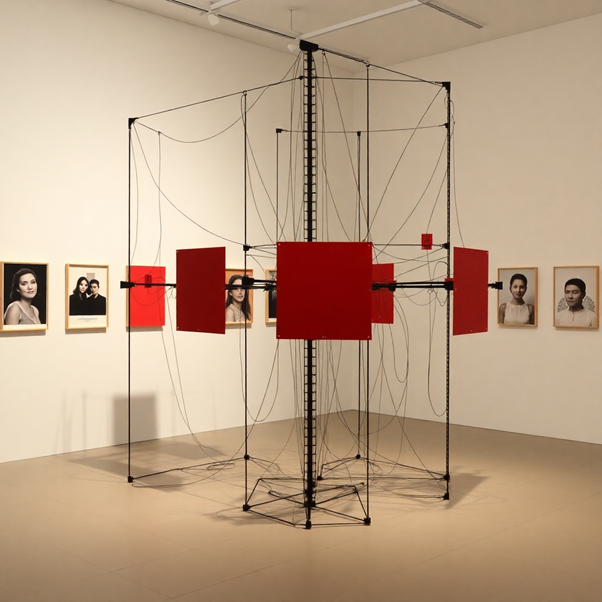
At the center of the exhibition is an interactive, physical interactive installation, built of a complex system of rods, stretched wires, and opaque surfaces in red elements that block, disguise, but also emphasize the connection between them and the images that surround them: portraits of human beings women, men, young and old all looking at the viewer, partners in the gaze but also victims of hidden structures of the collective subconscious.
The installation deals with the context of psychoanalysis that creates an experience of supervision, control, representation, and identity. It asks: Who determines what we see, who is present, and who disappears in personal existence.
The exhibition draws inspiration from Michel Foucault’s thought, especially from his writings on supervision, policing and biopolitics, in the connection between the mental andthe political.” As in their daughter’s and Foucault’s panopticon model, so too here control is not necessarily overt. It exists through thin mechanisms, transparent to the eye but tangible to the body and soul.
At the same time, there is an influence from the thought of Jacques Rancière, who speaks of the “division of the senses” (La Partage du Sensible) how power systems dictate who is allowed to speak, who is seen, and what knowledge is considered “legitimate.” The exhibition breaks down the. This order suggests another “disorder” in which the excluded voice is embodied
Interactive Space – “The Observer as the Observer”
The viewer becomes an integral part of the work his movement changes the angles of view, opens or blocks the images. As in the social reality, here too the choice to see (or hide) entails moral responsibility.
To raise questions about global power relations and representations in the visual media to expose the mechanisms that shape collective consciousness to offer a space of flexibility artistic action as a political act where the national and the global meet, is a perfect platform for examining cultural, moral and political boundaries. The work focuses on exactly that liminal space between the visible and the invisible, between thecultural and the individual, between control and freedom.
The installation features a light metal structure on which red panels are installed, connected to each other by a system of lines and wires, and around it hangs photographic portraits on the walls. The tension between the rigid geometric shape and the linear grid and the human face creates a charged field of power, memory, and control.
“Space as Power – Fields of Control and Memory”
The work places the viewer at an impossible encounter between a body and a system, between an interior and a power structure. The red boards are the color of an emergency, a warning, and sometimes a revolution, crossing the space like transparent barriers. They are part of an invisible control machine, one whose workers do not wave weapons, but rather wires, nets, and frames of thought.
The inspiration came from the encounter between Michel Foucault’s ideas on biopolitics and population management in social, psychopolitical, and Jean Baudrillard, who identified how simulcra replaces reality. The installation embodies the same mechanisms: the central structure resembles a monitoring device, and the system of lines connecting the parts simulates the flow of information about human details, detached from their context and becoming a currency of control.
The portraits on the wall are not just portraits; they are “documents” in the Baudrillian sense, representations of identities that have already been processed and abstracted. The red that cuts through the field of vision marks the gap between the human gaze and the system that filters, frames, and directs it.
In a Heideggerian sense, we live in a world as an engineering project, in which the person himself is measured and considered as a raw material. The threads in the installation are not just a formal element, they mark the networks of human experience, our dependence on technological structures, and the impossibility of detaching from them.
The work is also a call to break the existing order in psychotherapy, inspired by Herbert Marcuse, who offers the possibility of imagining a different reality a reality in which the network does not capture but reconnects, and red is no longer a warning color but a signal of liberation.
In the installation, there isa dialogue on the border between beauty and fragility, between tradition and a threatened future, the work takes on another layer: it sets up a mirror not only for the gallery, but for the entire world, where control of the state of mind is spread not through walls, but through invisible systems that organize our very consciousness.
“The Inner Tower – Rituals of Control in the Digital Age”
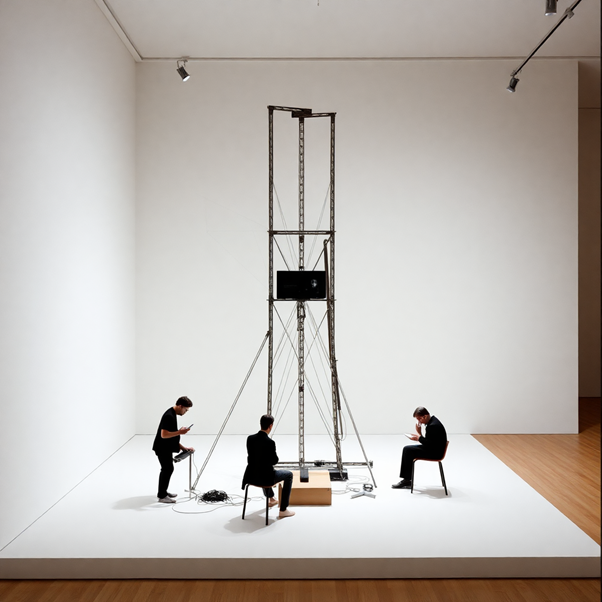
The structure stands like a broadcasting tower or a radio antenna, but also like the totem pole of an ancient tribe. It is the backbone of an era in which power travels through electronic signals, frequencies, and information traveling at the speed of light. Around it sit three human bodies, their heads bent into small screens, not to the world, but to a mediated and filtered space.
The work was born out of thought for the ideas of Michel Foucault, who showed how systems of power operate not only through physical coercion, but through the subtle organization of mind, body, and time. The tower here is not a 21st-century panopticon who observes from above, but one that each of its occupants carries inside, through the device in his hand.
Jean Baudrillard might have said that the screen in the center is no longer a means of transmitting reality, but a simulated reality with no origin behind it. Those sitting around the tower do not “communicate” but participate in a ritual of exchanging signs, a ritual in which the present is constantly replaced by an endless stream of representations.
The work also touches on the Heideggerian understanding of technology as a force that shapes our being the tower here is not just a tool, it is the horizon of vision and thinking, it is the order in which the person himself becomes an object in a system of reception and transmission.
As with Herbert Marcuse, here too the question arises whether we can still distinguish between freedom and control when the internal power structure is so integrated into our daily lives, those sitting around the tower are not prisoners in the simple sense; they are active partners in the apparatus, part of a self-reinforcing system.
This tower stands like a symbol of an era in which the boundaries between the center and the periphery, between the private and the public, and between human and technological, are blurring, until the real question is not who operates the tower, but who can stop operating it at all.
“Lines of Control – Breathing in a Framed Space”
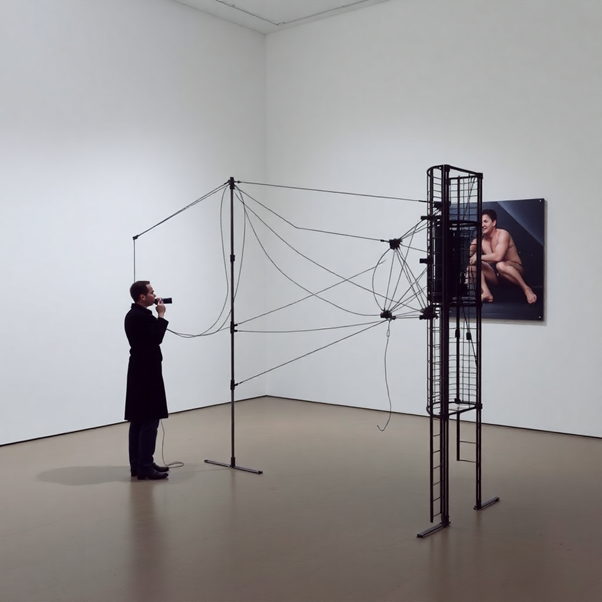
The work was born out of the need to understand space as a site of constant negotiation between the body and the mind, which exists within the social mechanismsthat activate it, expressed between the tense lines, like a spider’s web, connecting two poles: man and the system, on the one hand, man’s voice and breath are raw, vulnerable, and cannot be replicated perfectly, on the other hand, there is a metal technological structure whose function is to filter, Measure and frame the experience.
Inspired by Michel Foucault, the installation explores biopolitics as a form of control in which the body becomes a measured, analyzed, and managed object. Here, even the most basic human action breath becomes information that enters a web of threads, is captured and processed. The human being is no longer the source of experience but a link in the chain of data production.
Jean Baudrillard would have seen here the process in which the intimate is replaced by representation. The photograph of the naked figure is not the “body”, but rather a photograph that has passed through structures of gaze, coding, and presentation. It serves as evidence of the transition from the direct experience to the simulacre that stands in its place.
The work also corresponds with Hannah Arendt, in her distinction between the private sphere and the public sphere: here the boundaries between them are unraveled. The physical mechanism functions as a mediator or intruder who transfers the intimate into an open space for analysis, observation, and control.
Inspired by Herbert Marcuse, the installation is also a critique of the automation of consciousness, the human voice, which enters the system, may return to it as a processed signal, lacking the original oneness, as if freedom itself is swallowed up within a system that produces the boundaries of speech.
The boundary between the inside and the outside, between exposure and concealment, is presentin the sea in this work and offers a moment of re gaze: how we breathe, speak, and live in a world in which both the voice and the body are always in tension between freedom and the framework that surrounds them.Top of the form
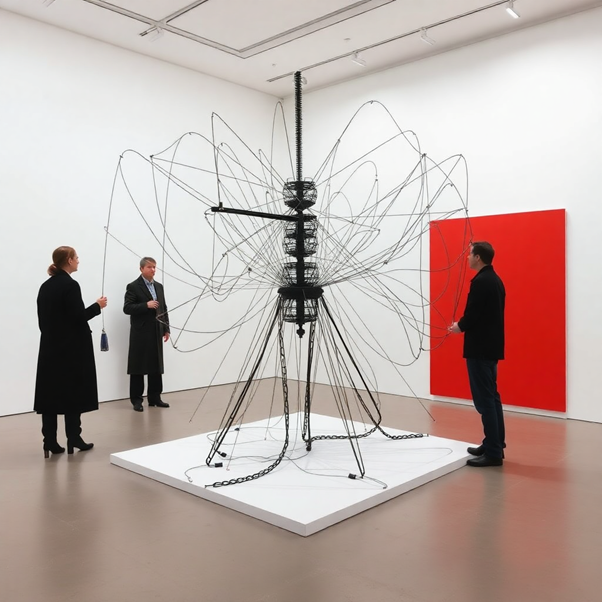
“Lines of Control – Breathing in a Framed Space”
The work was born out of the need to understand space as a site of constant negotiation between the body and the mind, which exists within the social mechanismsthat activate it, expressed between the tense lines, like a spider’s web, connecting two poles: man and the system, on the one hand, man’s voice and breath are raw, vulnerable, and cannot be replicated perfectly, on the other hand, there is a metal technological structure whose function is to filter, Measure and frame the experience.
Inspired by Michel Foucault, the installation explores biopolitics as a form of control in which the body becomes a measured, analyzed, and managed object. Here, even the most basic human action breath becomes information that enters a web of threads, is captured and processed. The human being is no longer the source of experience but a link in the chain of data production.
Jean Baudrillard would have seen here the process in which the intimate is replaced by representation. The photograph of the naked figure is not the “body”, but rather a photograph that has passed through structures of gaze, coding, and presentation. It serves as evidence of the transition from the direct experience to the simulacre that stands in its place.
The work also corresponds with Hannah Arendt, in her distinction between the private sphere and the public sphere: here the boundaries between them are unraveled. The physical mechanism functions as a mediator or intruder who transfers the intimate into an open space for analysis, observation, and control.
Inspired by Herbert Marcuse, the installation is also a critique of the automation of consciousness, the human voice, which enters the system, may return to it as a processed signal, lacking the original oneness, as if freedom itself is swallowed up within a system that produces the boundaries of speech.
The boundary between the inside and the outside, between exposure and concealment, is presentin the sea in this work and offers a moment of re gaze: how we breathe, speak, and live in a world in which both the voice and the body are always in tension between freedom and the framework that surrounds them.Top of the form
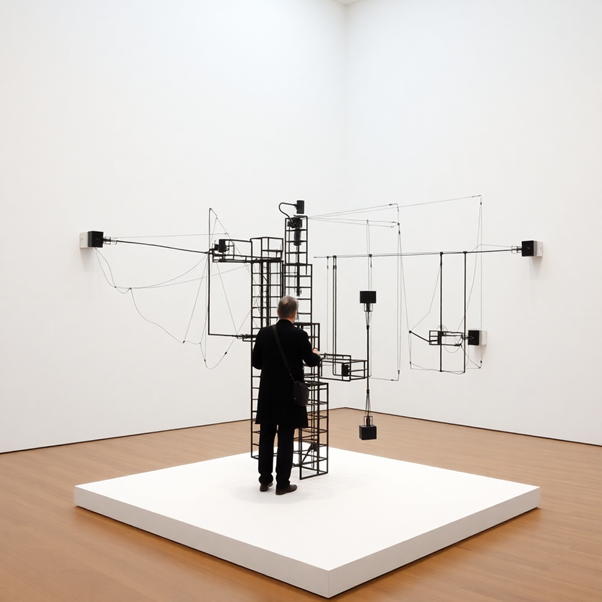
“The Records of Control: Between Body, Technology and Space“
The work stands as a kind of antenna of consciousness a constructive system that combines metal molds, wires, and knots that stretch between walls, and at its center is a single body, the viewer, which becomes part of the array. It is not a sculpture in the classical sense, but a map of control: a space in which invisible power relations are recorded, mediated, and maintained.
The project seeks to ask how we as human beings in the 21st century have become components of machines of surveillance, monitoring, and guidance. Michel Foucault, writing about the Panopticon, emphasized the transition from direct physical control to regimes of constant visibility. Here, the space presented is not a prison but an array of technological communication, in which the human body is the link that produces meaning.
Gil Deleuze, in his conceptualization of “control companies,” saw dynamic, coded, and decentralized systems as the next stage of institutional discipline. My work illustrates this transition: no longer physical boundaries, but intangible, flexible, and adaptive networks, within which we move without knowing when and how we are measured, routed, labeled.
But there is also a poetic reading here, influenced by Jean Baudrillard , who argued that in the age of simulation, the sign is detached from reality. The constructive structure does not represent a single “real system,” but rather imitates, simulates, and subjects us to the illusion of order and control. It raises questions about the essence of the signals we receive and the information we produce what is real and what is the image of the real.
At the same time, the work seeks to echo the thought of Herbert Marcuse, who criticized the suffocating embrace of technology as an arm of existing ideology. Here, the viewer himself is trapped between the lines of the system not as a prisoner, but as a collaborator, as someone who enables its action by his very presence.
The work was born out of an observation of a reality in which technological infrastructures communication cables, data centers, control protocols are the most transparent and influential at the same time. It poses the question do we touch the system, or does the system touch us, filter us, and map us as part of a global mechanism that has no center but countless points of connection
“The Records of Control: Between Body, Technology and Space“
The work stands as a kind of antenna of consciousness a constructive system that combines metal molds, wires, and knots that stretch between walls, and at its center is a single body, the viewer, which becomes part of the array. It is not a sculpture in the classical sense, but a map of control: a space in which invisible power relations are recorded, mediated, and maintained.
The project seeks to ask how we as human beings in the 21st century have become components of machines of surveillance, monitoring, and guidance. Michel Foucault, writing about the Panopticon, emphasized the transition from direct physical control to regimes of constant visibility. Here, the space presented is not a prison but an array of technological communication, in which the human body is the link that produces meaning.
Gil Deleuze, in his conceptualization of “control companies,” saw dynamic, coded, and decentralized systems as the next stage of institutional discipline. My work illustrates this transition: no longer physical boundaries, but intangible, flexible, and adaptive networks, within which we move without knowing when and how we are measured, routed, labeled.
But there is also a poetic reading here, influenced by Jean Baudrillard , who argued that in the age of simulation, the sign is detached from reality. The constructive structure does not represent a single “real system,” but rather imitates, simulates, and subjects us to the illusion of order and control. It raises questions about the essence of the signals we receive and the information we produce what is real and what is the image of the real.
At the same time, the work seeks to echo the thought of Herbert Marcuse, who criticized the suffocating embrace of technology as an arm of existing ideology. Here, the viewer himself is trapped between the lines of the system not as a prisoner, but as a collaborator, as someone who enables its action by his very presence.
The work was born out of an observation of a reality in which technological infrastructures communication cables, data centers, control protocols are the most transparent and influential at the same time. It poses the question do we touch the system, or does the system touch us, filter us, and map us as part of a global mechanism that has no center but countless points of connection
“Rating System”
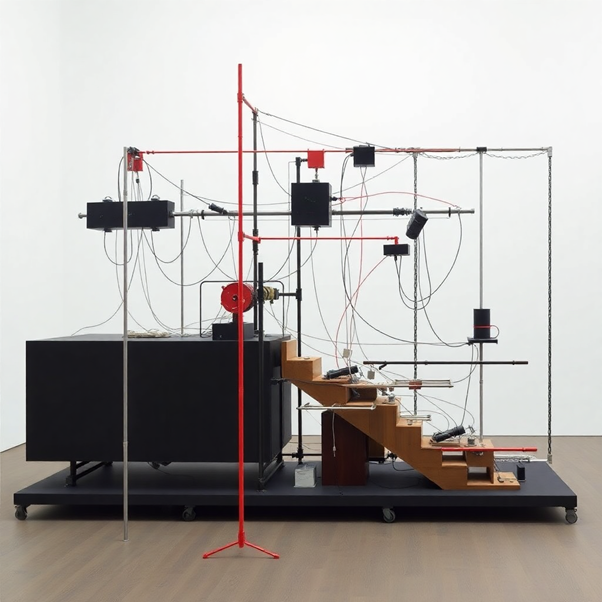
In front of the viewer stands a complex system, almost random looking, but charged with formal and material discipline: a metal structure in black and red, small wooden stairs leading out of nowhere, wires and electrical conductors that stretch and connect control points, cameras, and measurement assemblies. Everything stands on a mobile platform, as if it were a laboratory that can be dragged from one place to another a temporary mobility of a permanent control system.
The structure looks at once like a scientific experiment, a propaganda machine, or a scaled down image of urban infrastructure. But above all, it reveals a mechanism: a system of supervision, sorting, and operation, in which every component even if it seems marginal is part of a closed network.
Foreman, in his sharp look at the 21st century, poses a question here: How are control systems built so that they appear “natural”, part of our landscape, echoing Michel Foucault, who described in “The Birth of the Prison” the transition from overt and central power structures to decentralized, covert, and disciplined mechanisms. Furman’s system does not “control” physical force it controls by framing, measuring, and directing behavior.
At the same time, Gilles Deleuze, in his article “The Control Societies,” argued that power in the current era is not confined to rigid institutions (school, prison, factory) but flows through open, flexible systems that adapt and follow us in real time. Furman’s rating system exemplifies just that a system that can be moved, dismantled, changed, but is always there, ready to absorb and react.
The red and black threads, the visible connections, are reminiscent of Manuel Castelles’ metaphor for the “network company” physical and informational connections that redefine the power of institutions, states, and corporations, positioning the citizen as a data point within a giant graph.
The stairs a distinct component of work ascend in a blocked direction. They mark the promise of “progress” or “rise in status,” but they ultimately lead to a dead end. This is a harsh critique of the neoliberal model of social mobility, in which the system itself creates the illusion of possibilities, but in its structure, it locks them in advance.
The fact that work is mobile on wheels does not symbolize freedom, but on the contrary the ability of the system to move to new places, to adapt to different contexts, and never to disappear. Just as regulatory and economic bodies cross state borders without difficulty, while human beings the supervised remain restricted in their movement.
The viewer meets the work at a safe distance but realizes that he himself is already part of that system. It is documented, graded, mapped, like part of the process that the work describes. The installation is not just an image it is a physical experience of being in the system: a gaze that comes from above, threads that represent paths of information, a structure that does not allow you to forget your place within it.
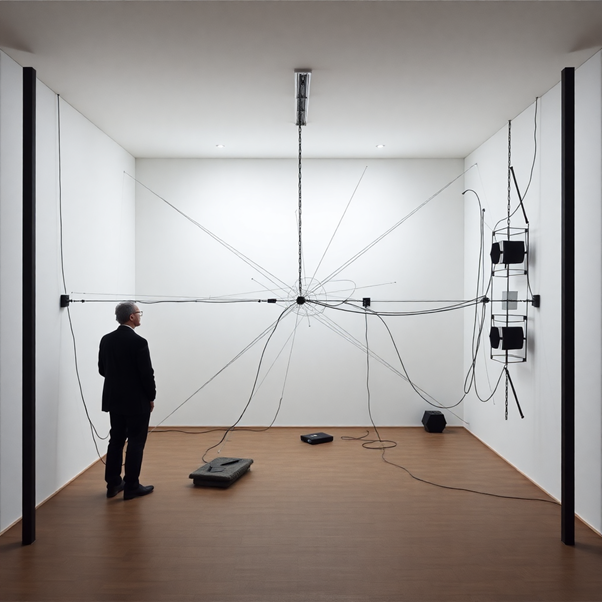
“Threads of control”
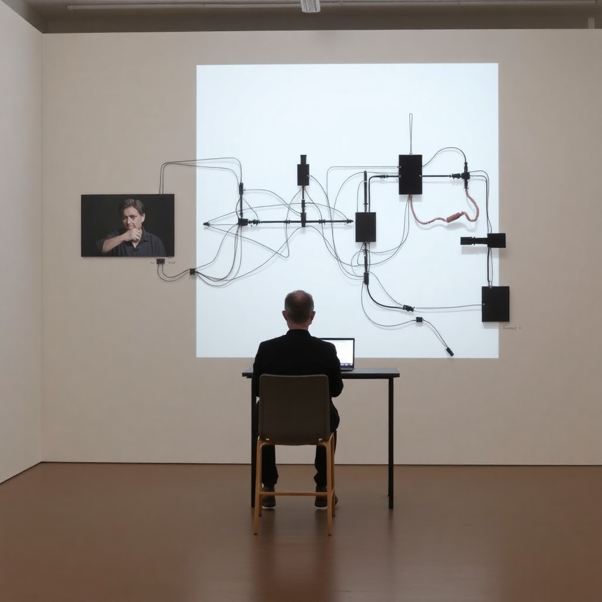
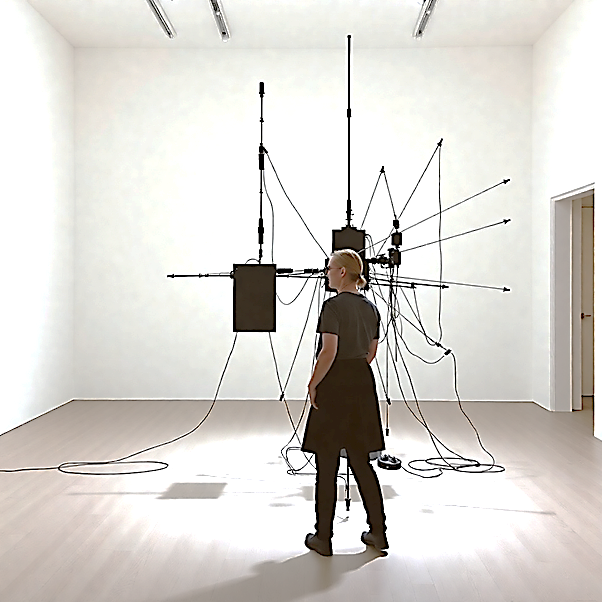
At the center of space is a complex system of cables, connections, control boxes, and devices whose identity and function are deliberately obscure. The system is spread out like an electronic spider in a sterile room and implies invisible control systems at work in our lives political, technological, and psychological. The lone person visiting is invited to stand in front of it, perhaps to be part of it, perhaps to oppose it.
The work draws inspiration from Michel Foucault’s thoughts on policing and supervision especially the perception of the “panopticon” as a metaphor for regimes of internal observation and control. I ask what has changed in the digital age: does supervision no longer need a clear structure, but rather takes place through transparent, invisible, embedded technologies, Does man, as in Gilles Deleuze’s vision, function in a reality of information that causes direction and classification?
The cables that break through the wall describe that explosion of information, of connections, of multi directional control. But also of the potential for disruption, of resistance. As in the writing of Jean Baudrillard, we are no longer witnesses to a “real” system, but to a simulation a network that has made itself a reality. In the meantime, man stands astonished, confused, perhaps indifferent. It is an attempt to examine how practices of power move from clear institutions state, police, school to gray spaces: monitoring technologies, concepts of normalcy, even moral discourse. Through this work, I ask What is the individual’s place in these structures? Does he still have the capacity to act?
The work also indirectly addresses contemporary situations of political repression, the regulation of information, and the disintegration of trust between citizens and the government. In the age of “post-truth,” whether the cables in the room are a means of communication or tools for deception, whether they convey messages or interrupt them.
This space is not just a representation of a technological system but of a deeper socio-political structure, in which the citizen serves as both an object and a subject of control. Through a thin, yet intense, visual language, I seek to propose a critical discourse that will challenge the gaze and open up questions – rather than providing answers.
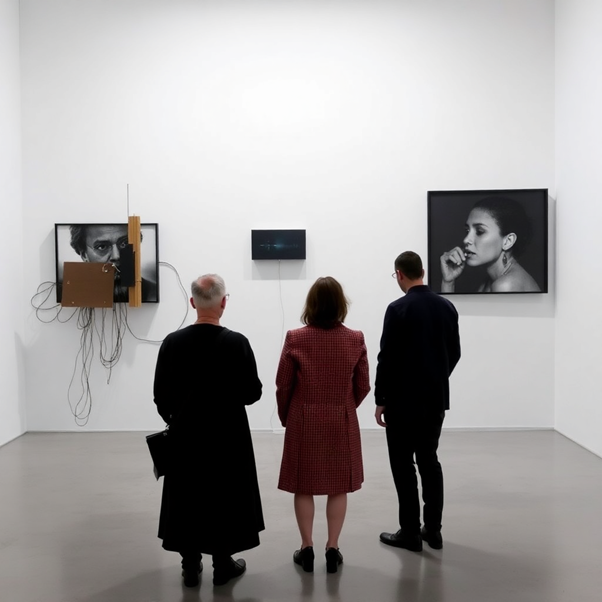
“Faces, connections, fragments”
The work was born out of an ongoing preoccupation with the question of identity, power, and visibility in contemporary digital and political society. In the space, we see a dialogue between three elements: a “clean” and intimate portrait of a woman looking out in charged silence; another, masculine portrait, partially hidden by intrusive material and technological intervention; and in the center a small, enigmatic digital screen that projects almost illegible content like a truth that has been deliberately concealed, The work explores the ways in which we create narratives about ourselves, the other, and the enemy and how media (both digital and artistic) serves as a tool of control or liberation.
Inspired by Foucault, the preoccupation with supervision and control through documentation and visual interpretation is strongly present here. Judith Butler also accompanies me, through the idea that the body is never only “natural” but has always been signified, gendered, and political. Finally, Edward Said, in his meditation on “Orientalism,” brings to the fore the danger of representation whether we show, or reinforce existing structures.
The combination of old media (black-and-white photography) and electronic devices, cables, and coarse or industrial materials creates a dissonance: the familiar and the human versus the alien and the systemic. Each part of the space seems to reveal a different layer of truth or disrupt the whole picture. It is a call to rethink the ways in which we consume images of others, especially in situations of suffering, war, migration, or oppression. The work seeks to ask who chooses the narrative and who is silent, because he has not been given the opportunity to speak.
In a reality in which algorithms determine what is revealed and what is forgotten, and in which faces become symbols, the work aims to restore the human gaze but also to challenge it. The three images are of real people, but their names and identities are not revealed. The emphasis shifts from the question of identity to the essence and how we choose to see, the work invites the viewer not to judge, but to pause. To feel uncomfortable. To ask Perhaps also to act.
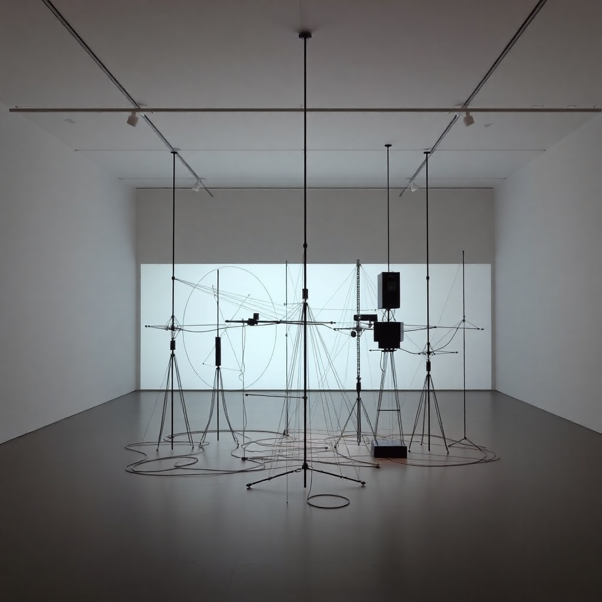
Supervision, Control, Representation, and Identity
This installation by Doron Furman confronts the viewer with a paradox that characterizes modern art in Adorno’s eyes: it is simultaneously a means of social criticism and a symptom of the cultural reality he is trying to expose. The work is not merely a visual object, but a situation in which the material elements, light, sound, and space create a dialectical tension between representation and identity, between an attempt to control reality and the necessary failure of such an attempt.
In his installation, Furman charts a path in which the viewer is required to recognize that visibility and image are not neutral. They are charged with a history of power, of supervision, of ideology and the viewer mediates between this mechanism and a personal understanding of himself. Here, art is not just an aesthetic experience but a critical tool, which allows the viewer to discern the coercion of industrial culture, the power of the establishment to shape identity, and the emotional stagnation that a socioeconomic structure imposes on the individual.
In terms of Adorno’s dialectical aesthetics, Furman’s installation brings together freedom and coercion, the viewer experiences the aesthetics of fragmentation an experience that raises questions about identifying with power, internalizing control, and the possibility of liberating consciousness within a rational-industrial reality. The work does not offer solutions or escape mechanisms, it exposes cultural and social oppression and invites the viewer to confront the tension between the conceptual and the sensory. between the aesthetic potential and the social reality that aesthetics must recognize.
Furman, then, does not just present a physical space: he creates a microcosm in which Adorno’s cultural critique takes shape art that cracks the aura of beauty, exposes the mechanisms that shape our consciousness, and establishes an encounter that forces the viewer to think about the relations of power, control, and identity in the modern age
The installation also explores the existential aspect of our presence in space. The threads connecting different tripods are reminiscent of Deleuze and Guattari’s “Rhizome”, in which paths, connections and interactions are spread out without a clear hierarchy. This creates an open structure, where each viewer can discover a different point of connection, but never completely control the entire system.
Furman’s installation is not only a visual exploration of form and space, but also a proposal for thinking about power relations, means of control, and the search for identity within complex systems. It is a space in which the viewer moves between observation and action, between awareness and oppression, between personal identity and part of the large network of objects and forces around him.